

Chicago, IL 60611 United States
Workshop Organizers


Overview
Mathematical Biology tends to involve a very small and specific (albeit extremely important and useful) branch of math, namely differential equations and dynamical systems. The vast majority of publications in which something biological is modeled present the model as a system of differential equations which are then solved, simulated, or otherwise analyzed for features like stability, limit cycles, hysteresis, etc. Meanwhile, huge swaths of mathematics are seldom if ever discussed in the context of biological problems. Examples include group theory, category theory, differential geometry, algebraic topology, number theory, the list goes on and on. For many important biological problems, differential equations may not be the correct representation. Such problems could be addressed in new ways by formulating the problem in different mathematical terms, allowing different mathematical approaches to be brought to bear while, at the same time, giving rise to new, interesting mathematical problems. Some of these problems might, in turn, serve as biological motivating exercises for teaching different areas of math to non-major students.
This workshop will bring together mathematicians working on areas not traditionally associated with “mathematical biology” and biologists interested in exploring their biological questions in new theoretical ways. The goal is to identify specific biological questions that could be viewed from different mathematical lenses, and to foster mutual interactions between the two groups in such a way that the mathematical attendees go away with new math problems to think about, i.e. problems that are interesting from a mathematical point of view, while the biologists go away with new perspectives on their problems and maybe an appreciation that there is much more in math besides solving equations.
Schedule
January 20 2026 Tuesday
8:30 am - 9:00 am
Breakfast
9:00 am - 9:15 am
Welcome & announcements - NITMB director
9:15 am - 9:30 am
Introduction from Mo and Wallace about goals of the workshop
9:30 am - 10:30 am
Lightning Talks, Part 1
(short talks, 90 seconds per talk, 1 slide per talk)
10:30 am - 11:00 am
Coffee Break
(discuss lightning talks)
11:00 am - 12:30 pm
Lightning Talks, Part 2
(short talks, 90 seconds per talk, 1 slide per talk)
12:30 pm - 1:30 pm
Lunch
(discuss lightning talks)
1:30 pm - 2:30 pm
Structured pairwise interactions based on abstracts
(Each session is 5 minutes)
2:30 pm - 3:30 pm
Free-form discussion among participants
(Participants choose who they want to work with. Form groups of 2-4)
3:30 pm - 3:40 pm
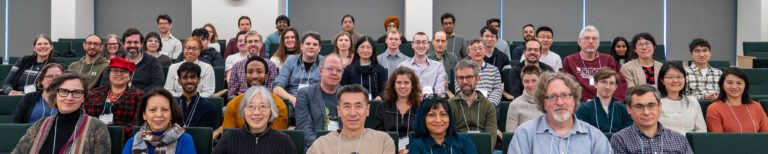
Group Photo
(Everyone gathers in the center seats of the Auditorium)
3:40 pm - 4:30 pm
Coffee Break
(If necessary, continue deciding groups during the break)
4:30 pm - 6:00 pm
Groups start working
(Develop a topic/collaboration idea. Create a few slides for the next day's presentation.)
6:00 pm - 7:30 pm
Working reception at NITMB
(this is considered dinner)
January 21 2026 Wednesday
8:30 am - 9:00 am
Breakfast
9:00 am - 9:05 am
Announcements - NITMB director
9:05 am - 10:00 am
Tutorials, Part 1
1. Yanlan Mao – Morphogenesis
2. David Spivak – Category Theory
3. Wenying Shou – Ecology
10:00 am - 10:30 am
Coffee Break
10:30 am - 11:30 am
Tutorials, Part 2
1. Paola Vera-Licona – Network Theory
2. Wallace Marshall – Cell Structure
3. Schmuel Weinberger – Algebraic Topology
11:30 am - 12:00 pm
Coffee Break
12:00 pm - 1:00 pm
Lunch with Groups
1:00 pm - 2:00 pm
Very brief presentation of group concepts
• Tutorial aspect: each group presents/explains one key area of math and of biology
• Research plan aspect: how the groups plan to combine the topics
• Impact for math
• Impact for biology
2:00 pm - 2:30 pm
Coffee break (and re-organization time)
a. People without groups meeting organizers to decide on new groups, or join existing groups
b. People can choose to switch groups
c. Group split and/or merge
2:30 pm - 3:00 pm
NSF Visitors
3:00 pm - 4:00 pm
Work in groups to develop ideas
Groups make list of potential problems, areas they would like to know more about, ask if anyone in a different group can provide advice, etc.
4:00 pm - 4:30 pm
Coffee Break
4:30 pm - 6:00 pm
Presentation of group progress with audience feedback
January 22 2026 Thursday
8:30 am - 9:00 am
Breakfast
9:00 am - 9:10 am
Announcements - NITMB director
9:10 am - 11:00 am
Groups work on ideas
11:00 am - 11:30 am
Coffee break
11:30 am - 12:30 pm
Groups work on ideas
12:30 pm - 1:30 pm
Lunch in groups
1:30 pm - 2:00 pm
Coffee Break
2:00 pm - 4:00 pm
Final Presentations
4:00 pm - 5:00 pm
Groups meet to make plans for how they will pursue the topic. Then go to dinner on their own.
Participants
Organizers
Moumita (Mo) Das – RIT
Wallace Marshall – UCSF
Participants
Michael Abbott – Yale University
Jun Allard – University of California, Irvine
Alberto Alonso – Rochester Institute of Technology
Antonio Auffinger – Northwestern University
Mohammed Saad Bhamla – Georgia Tech
Jing Chen – Virginia Tech
Ikchang Cho – University of Chicago
Stanca Ciupe – Virginia Tech
Adriana Dawes – Ohio State University
Salvador Escobedo – University of California, San Francisco
Ximena Garcia – University of California, San Francisco
Trevor GrandPre – Washington University
Omer Granek – The University of Chicago
Mini Harale – The University of Chicago
Joe Hibdon – Northeastern Illinois University
Andreas Hilfinger – University of Toronto Mississauga
Edith Hübner – University of Münster
Leroy Jia – National Institute of Standards and Technology
Margaret Johnson – Johns Hopkins University
Aravind Rao Karanam – Rochester Institute of Technology
Yeonghoon Kim – University of Michigan
Hagen Klobusnik – University of Connecticut
Istvan Kovacs – Northwestern University
Matthew Leighton – Yale University
Xinyi Liu – Northwestern University
Miranda Lynch – University at Buffalo/Hauptman-Woodward Institute
Yanlan Mao – University College London
Austin Marcus – University of California, Irvine
Noah Mitchell – University of Chicago
Soumik Mitra – Rochester Institute of Technology
Raphie Mostov – University of California, San Francisco
Dyche Mullins – University of California, San Francisco
Ed Munro – University of Chicago
Joe Nasser – Brandeis University
Minh Anh Nguyen-Dang – University of Chicago
Omayra Ortega – Sonoma State University
Mateus Palhares Viana – Allen Institute, Cell Science
Vishal Patil – University of California San Diego
Sonja Petrovic – Illinois Institute of Technology
Shrunal Pothagoni – George Mason University
Susanne Rafelski – Allen Institute, Cell Science
Michael Rust – University of Chicago
Gabriel Salmon – NITMB Fellow
Bhavneet Singh Saini – University of South Florida
Mariya Savinov – NITMB Fellow
Li Shen – NITMB Fellow
Farshad Shirani – Emory University
Wenying Shou – University College London
David Spivak – Topos Institute
Wanda Strychalski – Case Western Reserve University
Bianca Thompson – Westminster University
Paola Vera-Licona – University of Connecticut
Petia Vlahovska – Northwestern University
Jin Wang – Stonybrook University
Xueying Wang – NITMB Fellow
Shmuel Weinberger – University of Chicago
Jianhua Xing – University of Pittsburgh
Yunxi Yan – University of Chicago
Qiong Yang – University of Michigan
Polly Yu – University of Illinois Urbana-Champaign
Jia Zhao – University of Alabama
Adrianne Zhong – NITMB Fellow
Recordings
Yanlan Mao
Recorded on 01/21/2026
Title: Morphogenesis from a multicellular dynamics perspective
David Spivak
Recorded on 01/21/2026
Title: An attempt to explain category theory to biologists in 15 minutes
Wenying Shou
Recorded on 01/21/2026
Title: Ecology: Community Stability
Paola Vera-Licona
Recorded on 01/21/2026
Title: Mini Introduction to Network Biology
Schmuel Weinberger
Recorded on 01/21/2026
Title: Algebraic Topology and Geometric Metaphors in Biology