
Chicago, IL 60611 United States
Workshop Organizers
Claire Donnat, University of Chicago
Olga Klopp, ESSEC & CREST


Overview
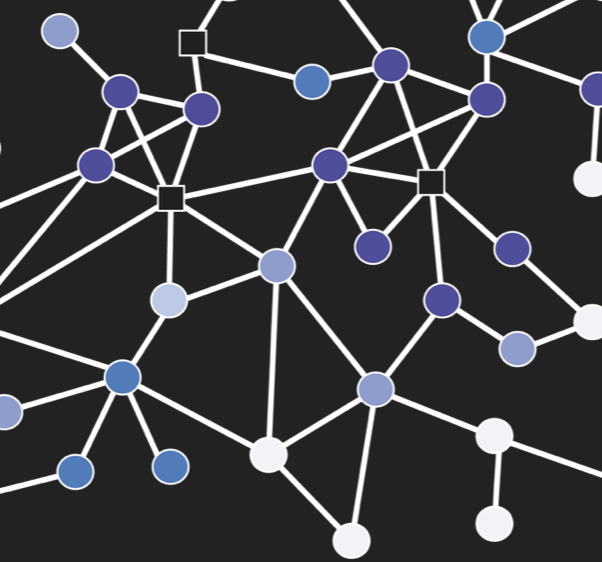
Graph Neural Networks (GNNs) are a recent extension of the neural network machinery to the graph setting that resolve the challenge of extending deep learning methods the peculiarities of network data by convolving node features across neighbourhoods to embed nodes in Euclidean space. Heralded as the breakthrough for machine learning on graphs that would allow the same “AI renaissance” that standard neural networks have brought to Computer Vision and Natural Language Processing, GNNs have been suggested as a panacea for a wide number of tasks across disciplines. In the biological sciences alone, GNNs have been applied to molecular design, drug-drug interaction predictions, biological networks,
knowledge graphs, and spatial transcriptomics.
Despite their popularity and widespread adoption, the theoretical foundations of GNNs remain underexplored. Fundamental questions about the mathematical principles driving their success, as well as their limitations, biases, and underlying statistical assumptions, are still unresolved. Notably, GNNs diverge significantly from traditional neural networks, with their architecture and function rooted in the unique properties of graph-structured data. These gaps in understanding could have significant implications in real-world applications, where issues revolving around bias and uncertainty must be rigorously addressed.
This workshop seeks to bring together researchers from statistics, computer science and computational biology to explore the theoretical and practical aspects of GNNs. The workshop will focus on topics revolving around three key themes:
• GNN Theory: Investigating foundational topics such as learning rates for classification and regression tasks, understanding the impact of different GNN architectures and the convolution operator.
• Uncertainty Quantification & Interpretability: Understanding the confidence and robustness of GNN predictions.
• Bias and Fairness: Exploring how GNNs may inadvertently propagate or amplify biases and ensuring equitable outcomes in their applications.
This two-day workshop will feature a series of focused deep-dive sessions, each dedicated to a core topic. These sessions will integrate expert talks with interactive discussions and structured brainstorming activities, led by small groups of participants, to foster collaboration and innovative thinking. The anticipated outcome of each session is the formulation of a precise research question and the initial framework of a research plan, providing participants with the opportunity to continue working on these topics beyond the workshop. The
workshop’s overarching goal is to produce a collaborative white paper that synthesizes the discussions, highlights key open questions, and outlines promising research directions in the theory and applications of Graph Neural Networks (GNNs).
Schedule
April 29 2025 Tuesday
Overview & Perspectives: A statistical take on GNNs & Mathematics of Deep Learning Chair: Claire Donnat Speakers: Matus Telgarsky, Arash Amini, Gaurav Rattan, Johannes Schmidt-Hieber, Morgane Austern, & Patrick Rubin-Delanchy
8:15 am - 8:45 am
Light Breakfast
8:45 am - 8:50 am
Welcome & Introduction of Institute
8:50 am - 8:55 am
Housekeeping Announcements
8:55 am - 9:00 am
Introduction to workshop: topics and objectives
9:00 am - 9:55 am
"Tangential vignettes from LLMs and deep learning" – Matus Telgarsky
9:55 am - 10:35 am
Talk: "A statistical take on GNNs" Session - Arash Amini
10:35 am - 11:05 am
Talk: "A statistical take on GNNs" Session - Gaurav Rattan
(remote on Zoom, broadcast at NITMB)
11:05 am - 11:15 am
Coffee Break
11:15 am - 12:15 pm
“Understanding the effect of GCN convolutions in regression tasks” – Johannes Schmidt-Hieber
12:15 pm - 1:15 pm
Lunch
1:15 pm - 1:55 pm
Talk: "A statistical take on GNNs" Session - Morgane Austern
1:55 pm - 2:35 pm
“The operation of a graph neural network when the graph follows a standard statistical model” – Patrick Rubin-Delanchy
2:35 pm - 2:45 pm
Introduction to the afternoon session
2:45 pm - 3:45 pm
Small Group Discussions - self selecting groups
3:45 pm - 4:00 pm
Coffee Break
4:00 pm - 4:30 pm
Report back
4:30 pm - 5:30 pm
Poster session & drinks
April 30 2025 Wednesday
Overview & Perspectives: Challenges in Manifold Learning & Beyond Graph Neural Networks Chair: Olga Klopp Speakers: Patrick Wolfe, Zaid Harchaoui, Risi Kondor, Nina Miolane, & Johannes Lutzeyer
8:30 am - 8:55 am
Light Breakfast
8:55 am - 9:00 am
Welcome & Housekeeping
9:00 am - 9:55 am
Talk: "Challenges in Manifold Learning" Session - Patrick Wolfe
9:55 am - 10:35 am
Talk: "Challenges in Manifold Learning" Session - Zaid Harchaoui
10:35 am - 11:05 am
Coffee break
11:05 am - 11:45 am
"Higher order graph neural networks with P-tensors” – Risi Kondor
11:45 am - 12:25 pm
"Topological Deep Learning” – Nina Miolane
12:25 pm - 1:30 pm
Lunch
1:30 pm - 2:10 pm
“We Need Metrics for the Localisation and Factorisation of Learning Tasks on Graphs” – Johannes Lutzeyer
2:10 pm - 2:20 pm
Introduction to the afternoon session
2:20 pm - 3:15 pm
Small Group Discussions - self selecting groups
3:15 pm - 3:30 pm
Coffee Break
3:30 pm - 4:00 pm
Report back
4:00 pm - 4:15 pm
Workshop Conclusion
Participants
Participants
Arash A. Amini – University of California, Los Angeles
Morgane Austern – Harvard University
Guillermo Bernardez Gil – University of California, Santa Barbara
Claire Donnat – University of Chicago (organizer)
Christophe Giraud – Laboratoire de Mathématiques d’Orsay
Zaid Harchaoui – University of Washington
Jing Rui He – University of Illinois Urbana-Champaign
Olga Klopp – École Supérieure des Sciences Economiques et Commerciales (organizer)
Risi Kondor – University of Chicago
Johannes Lutzeyer – École Polytechnique
Nina Miolane – University of California, Santa Barbara
Molly Noel – Rensselaer Polytechnic Institute
Gaurav Rattan – University of Twente
Bruno Ribeiro – Purdue University
Patrick Rubin-Delanchy – University of Edinburgh
Johannes Schmidt-Hieber – University of Twente
Matus Telgarsky – New York University
Hanghang Tong – University of Illinois Urbana-Champaign
Luciano Vinas – University of California, Los Angeles
Patrick Wolfe – Purdue University