
Chicago, IL 60611 United States


Overview
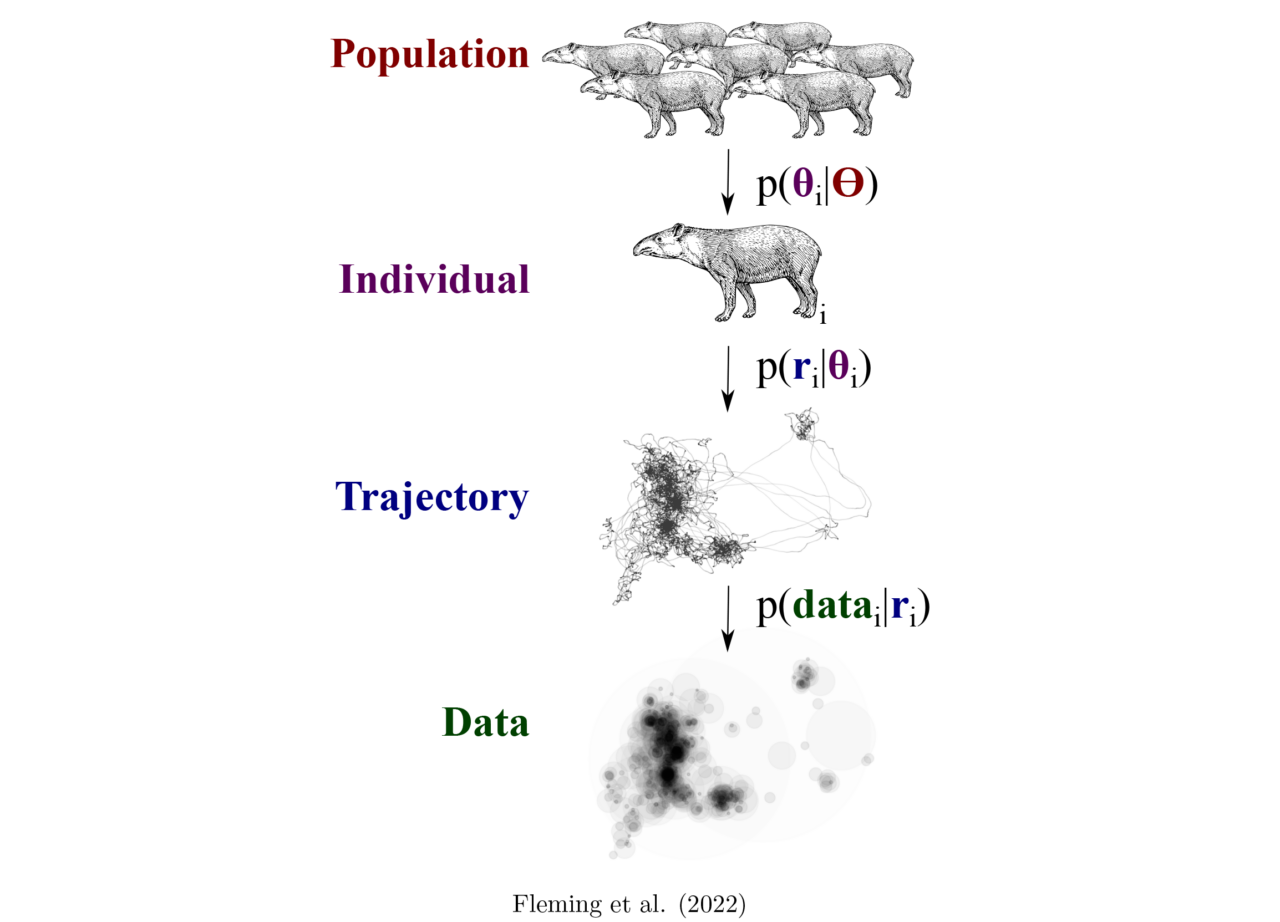
Understanding how individual movement behavior scales up to population-level patterns is a central challenge in ecology, epidemiology, and the study of spatially structured systems. The rapid growth of high-resolution tracking data has enabled the development of sophisticated stochastic-process models describing individual trajectories. Despite this progress at the individual level, a fundamental challenge remains: how do these data-driven movement models scale up to shape population-level outcomes such as spatial distributions, persistence, spread, and coexistence? This workshop will focus on advancing mathematical approaches for scaling up generally applicable individual-based movement models—particularly hierarchical continuous-time stochastic-process models—to population-level descriptions and inferences such as partial differential equations, network models, and density-based frameworks. By bringing together experts in applied mathematics, statistics, and ecology, the workshop aims to develop unified methodologies that connect empirical movement data with large-scale population processes. Addressing this scaling problem is essential not only for theoretical consistency, but also for improving the predictive power of models used in conservation planning, species management, and spatial population forecasting.