
Chicago, IL 60611 United States


Overview
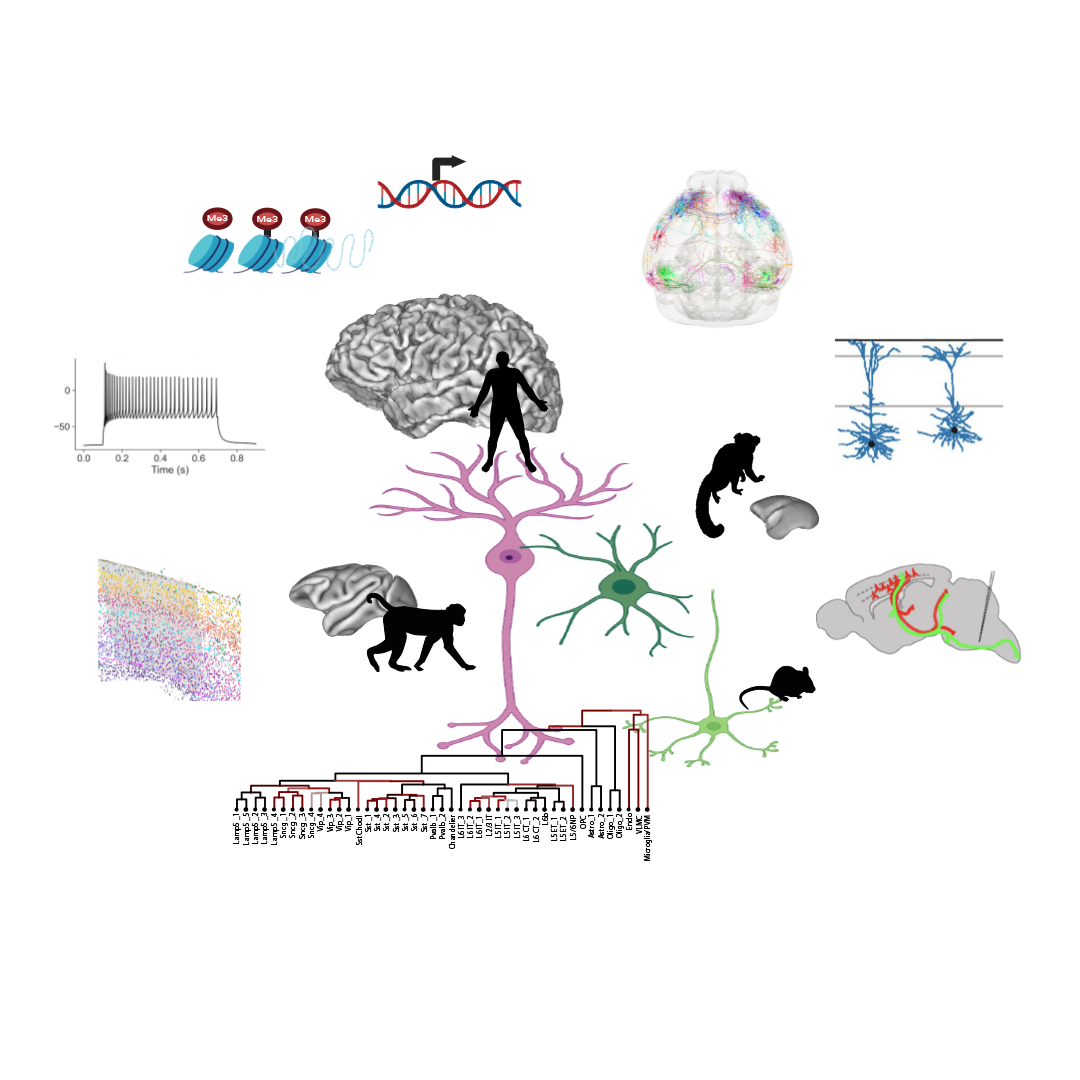
Cells in complex organisms exhibit substantial heterogeneity that is commonly represented through classification into discrete types. Nowhere is this diversity more pronounced than in the nervous system. Recent large-scale efforts, including the BRAIN Initiative Cell Atlas Network (BICAN), BRAIN Connectivity Across Scales (CONNECTS), and the Human Cell Atlas (HCA), have generated multimodal datasets containing millions of cells and have motivated hierarchical taxonomies comprising thousands of putative cell types.
Yet hierarchical classification provides only a partial description of the underlying biological landscape. Cellular identity may combine discrete structure with continuous variation arising from developmental trajectories, anatomical gradients, physiological and activity-dependent states, environmental influences, and experience-dependent plasticity. These biological sources of variation coexist with finite sampling, structured technical variability, and measurement noise, raising a fundamental question: to what extent do discrete cell-type classifications reflect intrinsic biological organization, and when are alternative or complementary representations required? Related challenges arise in aligning neural cellular identities across species, developmental stages, anatomical regions, and experimental modalities spanning transcriptomics, epigenomics, spatial measurements, morphology, connectivity, and electrophysiology. Moreover, widely used low-dimensional embeddings can substantially distort distances and neighborhood relationships in the original high-dimensional data, complicating visual interpretation of cellular structure.
These problems provide a compelling and concrete setting in which researchers in high-dimensional statistics, AI/ML, topological data analysis, manifold learning, graph and distribution alignment, and scientific visualization can develop and evaluate methods for characterizing structure in large, noisy, heterogeneous neural datasets. The goal of this workshop is to bring together quantitative researchers from these areas with experimental and computational biologists working directly with emerging cell-atlas datasets, with the aim of formulating a shared set of mathematical and computational problems and developing approaches that can be tested on currently available data.
The workshop will focus on three closely related themes: (1) the relationship between discrete cellular categories and continuous structure, (2) alignment of cell types across species, and (3) modeling developmental trajectories within species. First, new methods are needed to characterize discrete and continuous organization simultaneously, including hierarchical structure, gradients, transitional states, and uncertainty, thereby making definitions of cellular identity more robust and biologically interpretable. Second, cross-species alignment is needed to distinguish conserved cellular programs from evolutionary innovations and to provide a quantitative foundation for comparative biology and translation from model organisms to humans. Third, modeling development introduces an explicit temporal dimension, enabling reconstruction of lineage relationships and differentiation trajectories, identification of transitional states, and determination of when stable cellular identities emerge.
Beyond its potential to advance cell biology and neuroscience, the workshop offers an opportunity to develop broadly applicable methodology for high-dimensional analysis, visualization, manifold and topological inference, multimodal integration, and representation of mixed discrete–continuous structure. The scale, richness, and biological importance of emerging neural cell-atlas datasets make them an unusually powerful testbed for methodological advances with relevance to many areas of modern data science.