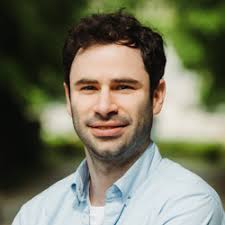
Alex Albaugh, Assistant Professor, Chemical Engineering and Materials Science, Wayne State University
The NSF-Simons National Institute for Theory and Mathematics in Biology comprises a wide array of investigators driving innovation at the interface of mathematics and biology. NSF-Simons NITMB Affiliate Members bring unique perspectives vital for developing new mathematics and inspiring biological discovery. One such NITMB Affiliate Member integrating mathematical disciplines with chemistry and biology to expand our understanding of biomolecular systems is Alex Albaugh.
Alex Albaugh is an Assistant Professor of Chemical Engineering and Materials Science at Wayne State University. The Albaugh Group works at the intersection of chemistry, physics, biology, computer science, chemical engineering, and materials science to understand how force-generating molecular motors function thermodynamically.
We spoke with Professor Albaugh to learn more about his work with molecular motors, the potential for this work to bridge the gap between theory, simulation, and biomolecular systems, and how NITMB provides an environment for inspiration and collaboration to drive this work forward.
What is a big question you’ve been asking throughout your research?
“The central theme of my research is systems that are out of equilibrium. The traditional domain of thermodynamics is equilibrium systems, but equilibrium is a restrictive set of conditions that are rare in reality. I like to push systems out of equilibrium to understand, predict, and design their behavior. As a computational chemist, my main tools are molecular simulation and thermodynamic theories. By creating out-of-equilibrium simulations, I can see the dynamics of systems play out on a computer. I’m particularly interested in motor proteins. These are biological engines that convert fuel to waste and produce work, a non-equilibrium process. Right now, my group is working on a model for myosin, a motor protein responsible for muscle movement and cellular transport. Beyond motor proteins, I also do simulation work on polymers in flow, dynamic catalysts, and vapor-deposited materials, all out-of-equilibrium systems.”
What disciplines does your research integrate?
“A great aspect of my work is how interdisciplinary it is. To build and use molecular simulations requires knowledge of programming, high-performance computing, applied math, and physics. The specific systems I’m interested in require domain knowledge in chemistry and biology. I’m in a fortunate position to be able to learn about such a breadth of subjects, and students in my lab have great opportunities to expand their scientific horizons.”
Where do you find inspiration?
“My most reliable sources of inspiration are nature, reading, and fellow researchers. I enjoy camping, hiking, and getting out into our wonderful national parks when I can. Contemplating how the principles of physics and chemistry that I work with lead to the variety of phenomena in the natural world can lead to new insights and questions. I recently took a trip with my family to Yellowstone National Park, and while watching geysers erupt, I couldn’t help but think about the thermodynamics at work deep under the earth that led to those spectacular sights. Reading, especially about the history of science, is also a great way to get into a creative research mindset. One of my favorite books is ‘Chaos’ by James Gleick, which tells the human story behind chaos theory. It emphasizes out-of-the-box, against-the-grain thinking and the importance of independence and curiosity in the research process. And enthusiasm is contagious, so I’ve often found myself getting excited about research that other researchers are excited about. Hearing Paul Dauenhauer talk about catalytic resonance inspired me to explore dynamic catalysis. My colleague Camille Bishop’s enthusiasm for glassy materials led me to develop simulations for vapor deposition.”
What aspects of your work could be interesting to mathematicians or applied to biology?
“From a mathematical/theoretical perspective, our motor protein simulations give an interesting testing ground for thermodynamic theories. At the molecular scale, systems have large fluctuations, and random chance plays an outsized role in the details of any particular simulation. The resulting ‘messiness’ of our data makes a connection to idealized mathematical theories challenging. I think there are interesting opportunities to bridge the gap between ‘clean’ theory and ‘messy’ simulation. From a biological perspective, I think of our simulations as a way to fill in details that are not currently experimentally accessible. They can provide a more detailed picture of the dynamics of biomolecular systems.”
What excites you about NITMB?
“I am particularly excited about NITMB’s mission to bring together experimental, computational, and theoretical researchers. For most of my career, I have been siloed into a computational bin, so I am looking forward to learning from and working with experimental researchers. I’m always looking for experimental data to improve our simulation models, and I’m always looking for inspiration for new systems to apply our methods to. NITMB provides a great environment for these collaborations.”
What career achievement are you most proud of?
“I am so proud of my research group. We’ve never been larger than three people, but the students that I have gotten to work with have all been curious, driven, and creative, exactly the kind of people you want to work with as a researcher. I like to say that we’re a small but mighty group. Watching students take a seed of an idea and grow it into their own project and become independent researchers along the way is one of the most rewarding parts of the job. Those moments when a student discovers something unexpected are particularly special.”
Outside of your research, what other interests do you have?
“I love spending time with my family. My wife and I have a two-year-old, who keeps us on our toes. It’s been a joy watching him grow and learn about the world. When I can, I enjoy running, reading, 3D printing, video games, and getting outdoors. I’m also a big college football fan, always pulling for my alma maters— the Michigan Wolverines, Cal Bears, and Northwestern Wildcats. “
What are you hoping to work on in the future?
“Molecular motors are truly fascinating to me. I’d like to push our methodology to more detailed, realistic models for motor proteins and expand from myosin into other systems like ATP synthase, dynein, and kinesin. I think increases in computational power and creative modeling choices can lead to big advances in this space. Collaborations with single-molecule experimentalists and stochastic thermodynamics theorists could help push this goal forward.”
More information on Professor Albaugh’s project and publications is available on the Albaugh Group website. Albaugh also invites anyone interested in his work or potential collaborations to reach out.
Related Posts