
Chicago, IL 60611 United States


Overview
Biological systems are physical systems operating in space and time. Understanding how they leverage dynamics and spatial extension to achieve functions, transforming physical cues into decisions, is a compelling challenge which requires new mathematical frameworks to identify and characterize emerging patterns in modern high-dimensional data, to quantify reproducibility, to describe how the information is encoded and transferred across scales, and to elucidate decision-making mechanisms.
The goal of this workshop is to bring together experimental biologists, specialists in data analysis and theorists to identify current challenges, establish collaborations, and discuss strategies to advance our understanding of how biological systems maintain and organize function across space and time. Researchers across biological subfields have developed formalisms and concepts adapted to their systems of interest. By breaking the traditional barriers of scale, we hope this meeting can be a way of identifying universal hallmarks disseminated across fields.
Schedule
September 14 2026 Monday
8:30 AM - 9:30 AM
Breakfast
9:30 AM - 9:45 AM
Welcome & Introduction
9:45 AM - 10:30 AM
Diana Pinheiro
Linking fate and shape in early embryogenesis
10:30 AM - 11:00 AM
Coffee break
11:00 AM - 11:45 AM
Guillaume Salbreux
Active nematics in tissue morphogenesis: waves and tubes
12:00 PM - 1:30 PM
Lunch
1:30 PM - 2:15 PM
Ehssan Nazockdast
Competing timescales of cell growth, mechanics, and osmotic forces govern tissue morphodynamics in hiPSC lumenoids
2:15 PM - 3:00 PM
Nicolas Romeo
Mechanical canalization of 3D chiral morphogenesis
3:00 PM - 3:30 PM
Break
3:30 PM - 5:00 PM
Poster session
September 15 2026 Tuesday
8:30 AM - 9:00 AM
Breakfast
9:00 AM - 9:45 AM
Jorn Dunkel
9:45 AM - 10:30 AM
Thierry Emonet
How information flow predicts navigation success
10:30 AM - 11:00 AM
Coffee break
11:00 AM - 11:45 AM
Gautam Reddy
A control perspective on cell-fate decision-making
12:00 PM - 1:30 PM
Lunch
1:30 PM - 2:15 PM
Margaret Gardel
Cellular Mechanical Information Processing
2:15 PM - 3:00 PM
Jonathan Colen
3:00 PM - 3:30 PM
Break
3:30 PM - 5:00
Poster session
5:00 PM - 5:30 PM
Free time
5:30 PM - 7:00 PM
Reception
September 16 2026 Wednesday
8:30 AM - 9:00 AM
Breakfast
9:00 AM - 9:45 AM
James Briscoe
The Dynamics of Neural Tube Development
9:45 AM - 10:30 AM
Danny Seara
Energy partitioning in the cell cortex
10:30 AM - 11:00 AM
Coffee break
11:00 AM - 11:45 AM
Elizabeth Jerison
Probing the spatiotemporal dynamics of inflammatory responses
11:45 AM - 12:00 PM
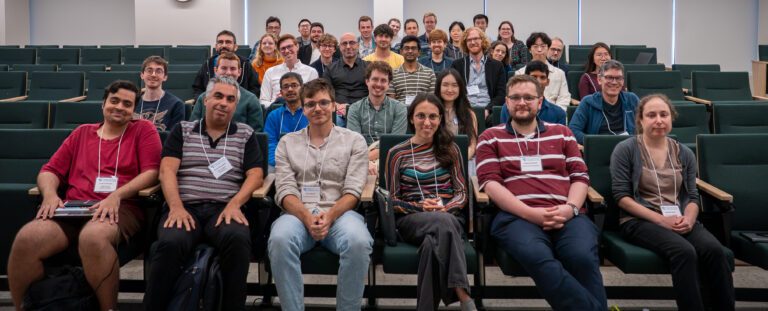
Group photo
12:00 PM - 1:30 PM
Lunch
1:30 PM - 4:00 PM
Discussion session
4:00 PM
Activity in the city (optional)
September 17 2026 Thursday
8:30 AM - 9:00 AM
Breakfast
9:00 AM - 9:45 AM
Suraj Shankar
Mechanics of immune sensing
9:45 AM - 10:30 AM
Mark Greenwood
Hormone oscillations preserve cellualr responsiveness to future physiological demands
10:30 AM - 11:00 AM
Coffee break
11:00 AM - 11:45 AM
Peter Foster
Physical bioenergetics of oocytes
12:00 PM - 1:30 PM
Lunch
1:30 PM - 2:15 PM
Kemal Keseroglu
Two Distinct Timers Control Vertebrate Embryo Segmentation
2:30 PM - 4:00 PM
Discussion/Free Time
September 18 2026 Friday
8:30 AM - 9:15 AM
Breakfast
9:15 AM - 10:00 AM
Alasdair Hastewell
Inter-limb coordination is stereotyped during takeoff dynamics across jumping spiders
10:00 AM - 11:00 AM
NITMB Seminar Series: Edouard Hannezo
Morphogenetic robustness from mechanochemical interactions
Developing tissues are inherently noisy: forces and biochemical signals vary in space and time, and neighbouring cells or structures display substantial heterogeneity. Yet morphogenesis is reproducible. I will discuss how mechanochemical feedbacks can buffer this variability, and under which conditions they instead amplify it. At the junctional scale, we identify in Drosophila epithelia an emergent mechano-response that ensures junction length and cell shape stability without a dedicated molecular force sensor. When negative and positive regulators of contractility have distinct turnover kinetics, junction elongation dilutes them differentially, transiently lifting an inhibition on contractility and restoring the initial length. Combining theory with live imaging and genetic perturbations, we show that this buffers local fluctuations and global stresses, and controls cell shape and tissue fluidity. At the tissue scale, we turn to crypt formation in the postnatal mouse intestine. Mechanical coupling through the shared villus would be expected to promote competition, and indeed generates winner-takes-all dynamics. Convergence instead requires transient villus swelling, which relaxes epithelial tension, combined with local density mechanosensing that synchronizes contractility across neighbouring crypts. We sketch a theoretical framework where the balance between local cooperation and global mechanical constraints, sets the lengthscale over which morphogenetic units compete or cooperate.
11:00 AM - 11:15 AM
Concluding remarks
11:15 AM - 12:00 PM
Free time
12:00 PM - 1:30 PM
Lunch
Participants
Organizers
- Federica Ferretti – NITMB
- Alasdair Hastewell – NITMB
- Alexander Mietke – University of Oxford
- Noah Mitchell – University of Chicago
- Nicolas Romeo – University of Chicago
Speakers
- James Briscoe – Francis Crick Institute
- Jonathan Colen – Old Dominion University
- Jorn Dunkel – MIT
- Thierry Emonet – Yale University
- Peter Foster – University of Southern California
- Margaret Gardel – University of Chicago
- Mark Greenwood – MIT
- Edouard Hannezo – Institute of Science and Technology, Austria
- Elizabeth Jerison – University of Chicago
- Kemal Keseroglu – Northwestern University
- Ehssan Nazockdast – Allen Institute
- Diana Pinheiro – Research Institute of Molecular Pathology
- Gautam Reddy – Princeton University
- Guillaume Salbreux – University of Geneva
- Danny Seara – University of Illinois Chicago
- Suraj Shankar – University of Michigan
Participants
- Fotios Avgidis – Yale University
- Amitava Banerjee – Weill Cornell Medical College
- Emmy Blumenthal – Princeton University
- Erin Brandt – Grand Valley State University
- Weitao Chen – University of California, Riverside
- Stephen Cini – University of Notre Dame
- Carles Falco University of Oxford
- Omer Granek – The University of Chicago
- Alana Hartsell-White – The University of Chicago
- David Hathcock – University of Toronto
- Catherine Ji – Princeton University
- Yiwen Jiang – Northwestern University
- Tobias Kiehntopf – University of Oxford
- Julius Kiln – University of Oxford
- Istvan Kovacs – Northwestern University
- Zhiwei Li – University of Chicago
- Huiling Liao – Illinois Institute of Technology
- Hailey Lynch – University of Notre Dame
- William Magrogan – University of Colorado, Boulder
- Billie Meadowcroft – University of Chicago
- Tushya Mehta – Northwestern University
- Jasmine Nirody – University of Chicago
- Ertugrul Ozbudak – Northwestern University
- Abinash Padhi – The University of Chicago
- Samares Pal – University of Kalyani
- Paul Robin – Institute Curie – CNRS
- Ankita Roychoudhury – Northwestern University
-
Greg Stephens – Vrije Universiteit Amsterdam
- Nils Estuardo Strand – The University of Chicago
- Aaron Winn – The University of Chicago
- Laeschkir Würthner – European Molecular Biology Laboratory
- Qiwei Yu – Princeton University
- Yuqian Yang – University of Michigan
- Shaowen Zhu – The University of Chicago
Recordings
Ehssan Nazockdast
Recorded on 09/14/2026
Title: Competing timescales of cell growth, mechanics, and osmotic forces govern tissue morphodynamics in hiPSC lumenoids
Nicolas Romeo
Recorded on 09/14/2026
Title: Mechanical canalization of 3D chiral morphogenesis
Jorn Dunkel
Recorded on 09/15/2026
Title: Learning stochastic models of living matter
Thierry Emonet
Recorded on 09/15/2026
Title: How information flow predicts navigation success
Margaret Gardel
Recorded on 09/15/2026
Title: Mechanical Information Processing in Adherent Cells
James Briscoe
Recorded on 09/16/2026
Title: Deconstructing and reconstructing neural tube development
Danny Seara
Recorded on 09/16/2026
Title: Energy partitioning in the cell cortex
Elizabeth Jerison
Recorded on 09/16/2026
Title: Probing the dynamics of inflammatory responses
Suraj Shankar
Recorded on 09/17/2026
Title: Mechanics of immune sensing
Mark Greenwood
Recorded on 09/17/2026
Title: Design principles of endocrine signaling in space and time
Alasdair Hastewell
Recorded on 09/18/2026
Title: Inter-limb coordination is stereotyped during takeoff dynamics across jumping spiders
Edouard Hannezo
Recorded on 09/18/2026
Title: Morphogenetic robustness from mechanochemical interactions