
Chicago, IL 60611 United States


Overview
Organisms are held together by cooperation between their constituent parts: genes, genomes, and cells. This intimate integration underpins the complex adaptations that characterise plants, fungi, and animals. Like any collective, however, organisms are vulnerable to exploitation from within, whether by selfish genetic elements enhancing their own transmission at the expense of other genes or selfish cell lineages, such as cancerous tumours, diverting resources away from the organismal optimum. Internal conflicts arise because different constituent parts experience optimal fitness under mutually exclusive conditions.
While the presence of within-organism conflicts is well-established empirically, their implications for organismal biology are poorly worked out. The mathematical frameworks we currently use—including inclusive fitness, game theory, population and quantitative genetics—generally assume that organisms are coherent, unified wholes, and they brush aside the existence of internal conflicts. Whereas the mathematics of cooperation has developed alongside its empirical study and has given rise to a coherent framework for understanding cooperation in various contexts, the mathematics of internal conflict has by and large lagged its empirical understanding and led to a proliferation of ad hoc models. Closing this knowledge gap requires developing a general mathematical framework that can make sense of organismal biology in the face of internal conflicts and meet the need for a formal theory of internal conflict.
Schedule
June 15 2026 Monday
8:30 am - 9:00 am
Breakfast
9:00 am - 9:15 am
Welcome
9:15 am - 10:00 am
Arvid Ågren and Manus Patten
Tutorial 1: A survey of internal conflicts
10:00 am - 10:15 am
Coffee Break
10:15 am - 11:15 am
Maria Orive
Tutorial 2: The Price equation and evolutionary change: a framework for modeling conflict
11:15 am - 12:15 pm
Geoff Wild
Tutorial 3: Inclusive fitness
12:15 pm - 1:45 pm
Lunch
1:45 pm - 2:45 pm
Hanna Kokko
Tutorial 4: What is population fitness?
2:45 pm - 3:00 pm
Coffee Break
3:00 pm - 4:00 pm
Steve Frank
Tutorial 5: Conflicts in cancer
4:00 pm - 5:00 pm
Jason Wolf
Tutorial 6: Genetic systems and internal conflicts
5:00 pm
Adjourn for dinner out as a group
June 16 2026 Tuesday
8:30 am - 9:00 am
Breakfast
9:00 am - 9:10 am
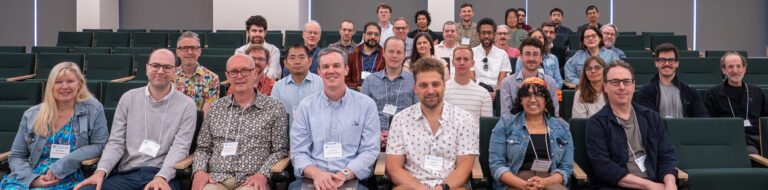
Welcome & Group Photo
9:10 am - 10:30 am
Research talks (x4)
10:30 am - 11:00 am
Coffee Break
11:00 am - 12:20 pm
Research talks (x4)
12:30 pm - 1:45 pm
Lunch
1:45 pm - 2:45 pm
Research talks (x3)
2:45 pm - 3:00 pm
Coffee Break
3:00 pm - 4:00 pm
Research talks (x3)
4:00 pm - 6:00 pm
Reception (with discussion topics front of mind)
6:00 pm
Adjourn for dinner on your own
June 17 2026 Wednesday
8:30 am - 9:00 am
Breakfast
9:00 am - 9:30 am
Welcome and Discussion of discussion topics: the sieve
9:30 am - 10:30 am
Research talks (x3, if needed)
10:30 am - 11:00 am
Coffee Break
11:00 am - 12:30 pm
Breakout groups for discussion
12:30 pm - 2:00 pm
Lunch
2:00 pm - 3:00 pm
Breakout groups for discussion
3:00 pm - 3:30 pm
Coffee Break
3:30 pm - 5:00 pm
Breakout groups for discussion
5:00 pm
Adjourn for dinner on your own
June 18 2026 Thursday
8:30 am - 9:00 am
Breakfast
9:00 am - 9:10 am
Welcome and Instructions
9:10 am - 10:30 am
Discussions
10:30 am - 11:00 am
Coffee Break
11:00 am - 12:30 pm
“Final” reports and closing ceremonies
12:30 pm - 2:00 pm
Lunch
2:00 pm - 3:00 pm
(for remaining people) Breakout groups for discussion
3:00 pm - 3:30 pm
Coffee Break
3:30 pm - 5:00 pm
(for remaining people) Breakout groups for discussion
5:00 pm
Adjourn for dinner on your own
Participants
Organizers
Arvid Ågren – Cleveland Clinic
Thomas Hitchcock – RIKEN
Manus Patten – Georgetown University
Martijn Schenkel – Wageningen University
Nina Wedell – University of Melbourne
Tutorialists
Joel Brown – Moffitt Cancer Center
Hanna Kokko – Johannes Gutenberg University Mainz
Maria Orive – University of Kansas
Geoff Wild – Western University
Jason Wolf – University of Bath
Participants
Austin Burt – Imperial College London
Steve Frank – University of California Irvine
Andy Gardner – University of St. Andrews
David Haig – Harvard University
Abdel Halloway – Case Western University
Thomas Keaney – Johannes Gutenberg University Mainz
Cody McCoy – University of Chicago
Pavitra Muralidar – University of Chicago
Elizabeth Ostrowski – University of Washington Bothell
Armin Schulz – University of Kansas
Jacob Scott – Cleveland Clinic
Francisco Úbeda – University of London Royal Hollow
Rob Unckless – University of Kansas
Carl Veller – University of Chicago
Stuart West – University of Oxford
Recordings
Manus Patten
Recorded on 06/15/2026
Title: A survey of internal conflicts
Maria Orive
Recorded on 06/15/2026
Title: The Price equation and evolutionary change: a framework for modeling conflict
Geoff Wild
Recorded on 06/15/2026
Title: Inclusive fitness
Hanna Kokko
Recorded on 06/15/2026
Title: What is population fitness?
Steve Frank
Recorded on 06/15/2026
Title: Conflicts in cancer
Jason Wolf
Recorded on 06/15/2026
Title: How social interactions shape the genotype-phenotype relationship and generate internal conflicts
Jake Scott
Recorded on 06/16/2026
Title: Harnessing internal conflict as a therapeutic strategy
Manisha Munasinghe
Recorded on 06/16/2026
Title: Transposable Element Linked Promoter Structural Variants Are Drivers Of Genome-Wide Differential Expression
Andy Gardner & Francisco Úbeda
Recorded on 06/16/2026
Title: The meaning of intragenomic conflict
Chuliang Song
Recorded on 06/16/2026
Title: A Theory of Holobiont Speciation
Pavitra Muralidhar
Recorded on 06/16/2026
Title: Cooperation within the genome promotes sex chromosome stability
Tom Keaney
Recorded on 06/16/2026
Title: The Evolutionary Conflicts of Inbreeding
Thomas Hitchcock
Recorded on 06/16/2026
Title: Linkage generates conflict within genomes
Tom Scott
Recorded on 06/16/2026
Title: No clear support for greenbeard genes
Elizabeth Ostrowski
Recorded on 06/16/2026
Title: The causes and consequences of microchimerism: a test of evolutionary theory in a wild carnivore population
Abdel H. Halloway
Recorded on 06/16/2026
Title: Ecological conditions for the evolution of cooperation under parent-offspring conflict
George Jarvis
Recorded on 06/16/2026
Title: Evolution of life history in pregnancy
Recorded on 06/16/2026
Title: Direct and indirect adaptation mediated by transposable elements
Recorded on 06/16/2026
Title: The evolution of suppressors of meiotic drivers
Carl Veller
Recorded on 06/16/2026
Title: Quantitative system drift