The NSF-Simons National Institute for Theory and Mathematics in Biology comprises a wide array of investigators driving innovation at the interface of mathematics and biology. NSF-Simons NITMB Affiliate Members bring unique perspectives vital for developing new mathematics and inspiring biological discovery. One such NITMB Affiliate Member integrating mathematics and biology to explore cellular processes is Calina Copos.
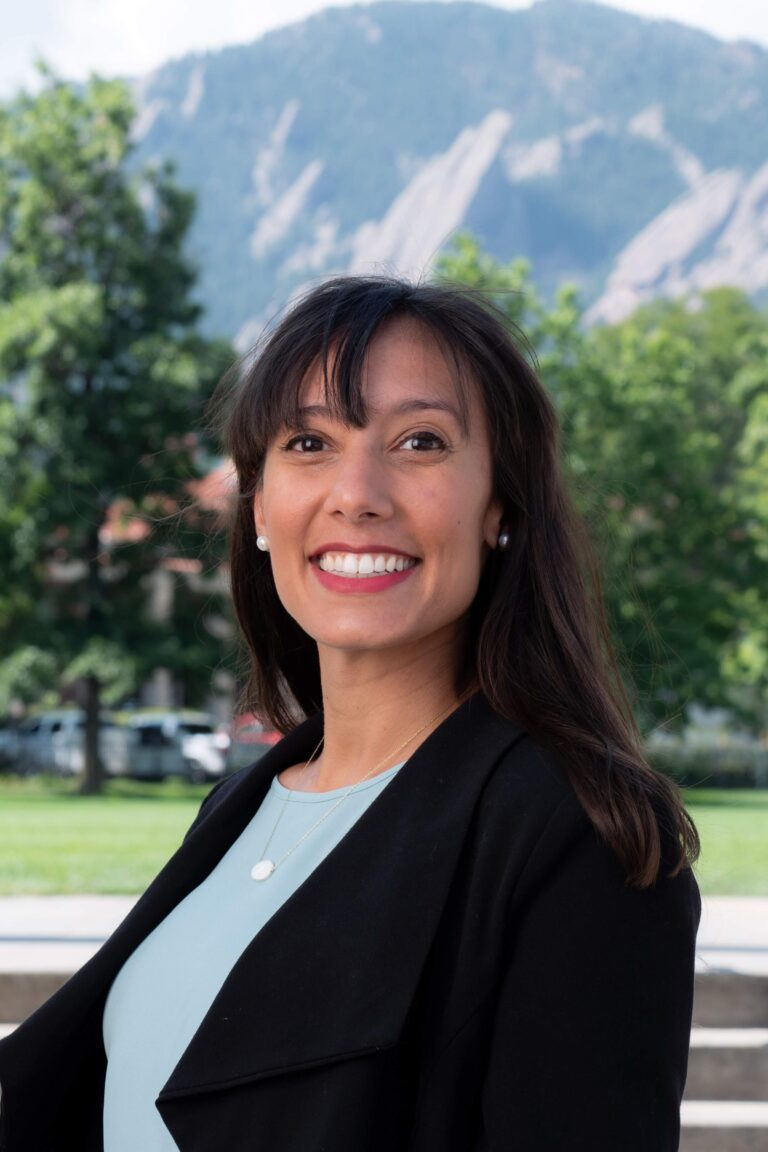
Calina Copos is an Assistant Professor at Northeastern University, with dual appointments in Mathematics and Biology. The Copos Lab is broadly interested in the mathematical biology of the cell, developing models and new mathematical tools to explore subcellular machinery during dynamic processes like cell migration. The group integrates image-based analysis, stochastic simulation, and physics-informed mathematical modeling to quantitatively describe complex biological systems.
We spoke with Calinia Copos to learn more about her research, how integrating mathematics and biology reveals new insights about the cell, and how NITMB supports this work by building bridges between disciplines.
What is a big question you’ve been asking throughout your research?
“I develop mathematical models of cellular processes, predominantly migration, pattern formation, and actomyosin cytoskeleton dynamics. In the last year or so, we’ve been really interested in observations of chirality, or the lack of geometrical mirror symmetry, at the cellular level. The story of chirality, or symmetry breaking, is not new and quite fundamental in a number of biological systems. What is new is the level of experimental detail that we have access to and that we can use to interrogate the origin of this observation. In a simple but carefully designed setup, our collaborators, Laetitia Kurzawa in the Cytomorpho Lab of Manuel Thery and Laurent Blanchoin, discovered that certain cell types have a directionality preference in their movement. They found that this directionality preference is tunable, environment-dependent, and system size-dependent. I believe it will reveal some important lessons about how a cell resolves two competing needs in the organization of the internal cellular cytoskeleton. Mathematically, we are throwing a number of tools at the problem, including continuum mechanics, agent-based models, biochemical pattern formation, and dynamical systems analysis. It’s very exciting, and we’ve already made some interesting discoveries.”
What disciplines does your research integrate?
“Broadly speaking, we are interested in problems that lie at the intersection of mechanics, numerical and computational methods, and cell biology. We work in single and collective cell migration, pattern formation, actomyosin cytoskeleton dynamics, and a growing interest in collagen extracellular matrices. Across these systems, we try to understand how interactions among cells, their cytoskeletal structures, and their physical environments give rise to organized behaviors across scales.”
Where do you find inspiration?
“I find myself drawn to problems that seem quite simple at first glance but unveil a much more mysterious story when you really peel back the layers. I am especially drawn to examples where simple systems exhibit quite complex behaviors. For instance, a pair of cells that prefer to migrate in one direction over another, a system-size-dependent response (too big vs. too small), a limb regrows if the epithelium is soft or remodels easily. I also find a lot of inspiration in conversations with experimentalists and students. I find that they often make me look at a familiar problem from a completely different angle.”
What aspects of your work could be interesting to mathematicians or applied to biology?
“I think the answer goes both ways! There are some really interesting mathematical questions in terms of whether this symmetry-breaking process is established at the cellular boundary and propagates inwards or vice versa, whether it is driven by biochemical or mechanical instabilities, and the overall role of mechanics and physical domain. From a biological or application point of view, chirality has been demonstrated to play a role in embryonic development, tumor metastasis, wound healing, and even synthetic biology in blood vessel formation.”
What excites you about NITMB?
“What excites me most about the NITMB mission is its commitment to bringing mathematics and biology into genuine conversation. My research is motivated by biological questions, but I often approach them through the lens of an applied mathematician, asking how relatively simple physical and mathematical principles can give rise to complex cellular and tissue-scale behaviors. NITMB provides a community where developing new mathematics and gaining biological insight are not separate goals, but can inform one another. Having such a community with workshops and seminars is important not just for myself, but for my trainees. I am particularly excited by the opportunity to interact closely with researchers who think about biological problems from very different perspectives. For my research program, NITMB would help remove disciplinary barriers by creating an environment in which new collaborations and ideas can develop naturally, while also inspiring me to push the mathematical foundations of my work further.”
What career achievement are you most proud of?
“Most recently, I was awarded an NSF CAREER to support our work on multiscale models for the cellular and tissue properties that distinguish wound healing from regeneration. It’s an absolute honor to receive this award and have our work be recognized at this level. I am also very proud of my students whose research efforts are being recognized both internally (university awards) and internationally. This past month, my graduate student, Samantha Finkbeiner, was awarded the prestigious NIH F31 fellowship.”
Outside of your research, what other interests do you have?
“My parents fostered an interest in art and creative expression from a young age — I think my two engineer parents hoped I would become an artist. In the past, some artistic outlets have been painting, drawing, pottery, and papercraft, but more recently it’s been sewing, embroidery, and with the birth of my niece, I became interested in felting. My husband and I also enjoy going on bike rides and long walks around Boston neighborhoods, and trying out new restaurants.”
What are you hoping to work on in the future?
“We have a number of exciting early-stage collaborations, and I really look further to growing these scientific endeavors over the years. That being said, we’re always open to new collaborations with theorists and experimentalists alike! I would also love to have the opportunity to reconnect with my background in fluid mechanics and work on problems where fluid flows are crucial to a particular biological observation.”
More information on Professor Copos’ work is available on the Copos group website. The Copos group is looking to hire a postdoctoral researcher with expertise in mechanics and numerical methods for PDEs, and Professor Copos encourages interested candidates to reach out.