
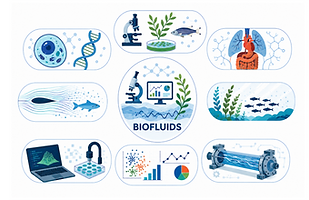
This image was generated from a hand-drawn sketch enhanced with ChatGPT.
Share:
July 26 - 30, 2027
Computational Biofluids at PUIs: Building Collaborations and Sustainable Research Trajectories as Teacher-Scholars
Location
Workshop Organizers
NITMB
Overview
Computational biofluids research lies at the intersection of fluid mechanics, applied mathematics, scientific computing, biology, and physics, and is increasingly shaped by data science, artificial intelligence, biomedical engineering, and experimental methods. While this interdisciplinarity creates rich opportunities for discovery, it also adds complexity particularly for faculty at primarily undergraduate institutions (PUIs). PUI faculty operate within demanding environments that include heavy teaching loads, undergraduate-focused research mentoring,
limited infrastructure, and significant service commitments. These challenges are further intensified by constraints on grant writing, fragmented research time, and the need to balance disciplinary depth with interdisciplinary breadth.
This workshop is designed to support PUI researchers in computational biofluids by promoting practical, sustainable strategies for conducting high-impact research. Through a collaborative and community-centered approach, participants will explore interdisciplinary partnerships, efficient research models, and ways to reduce cognitive and mentoring load while maintaining rigorous scholarship. The workshop will foster connections among researchers in mathematics, biology, physics, engineering, data science, and other disciplines. Participants will form working groups aimed at establishing new lines of inquiry including shared projects, funding strategies, student training, and/or joint mentoring. It will also emphasize meaningful undergraduate
engagement, including approaches to broaden participation among first-generation and underrepresented students. Participants will explore ways in which they could link experiments to theory or integrate emerging tools such as AI and data-driven methods into their teaching and/or research, and discuss practical and ethical implications. Ultimately, the workshop aims to empower PUI faculty to thrive as teacher–scholars by balancing research, teaching, and service, while building a supportive interdisciplinary community that sustains productivity and innovation in computational biofluids research.