
top of page

Summer Undergraduate
Research Program
Applications for the Summer 2026 program are due Monday, January 26, 2026 by 11:59pm central

​

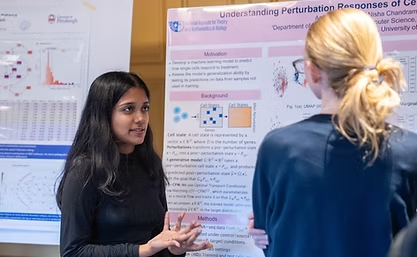
The NITMB Summer Undergraduate Research Program offers summer fellowships to undergraduates to engage in research at the interface between mathematics and biology. Students majoring in mathematics, biology, statistics, computer science, or related fields are invited to participate in hands-on laboratory or computational research that applies quantitative concepts and methodology to understanding mechanisms in biology. 
Selected students will be matched with a faculty mentor from the program.​

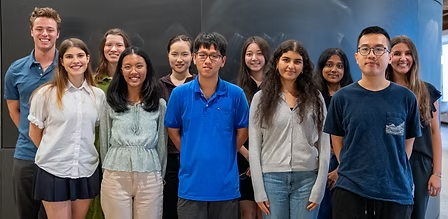
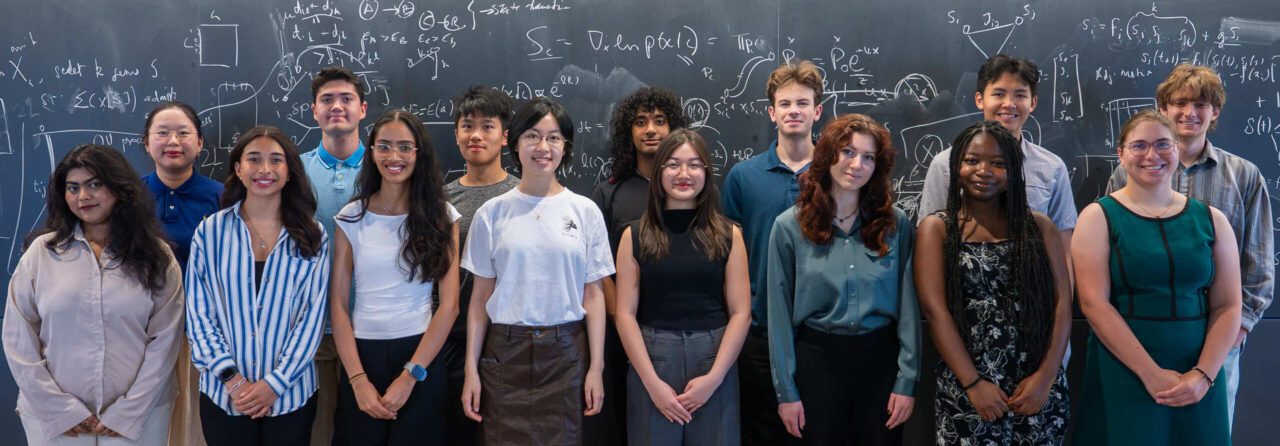
SURP 2025 Group Photo 07_16_25.png

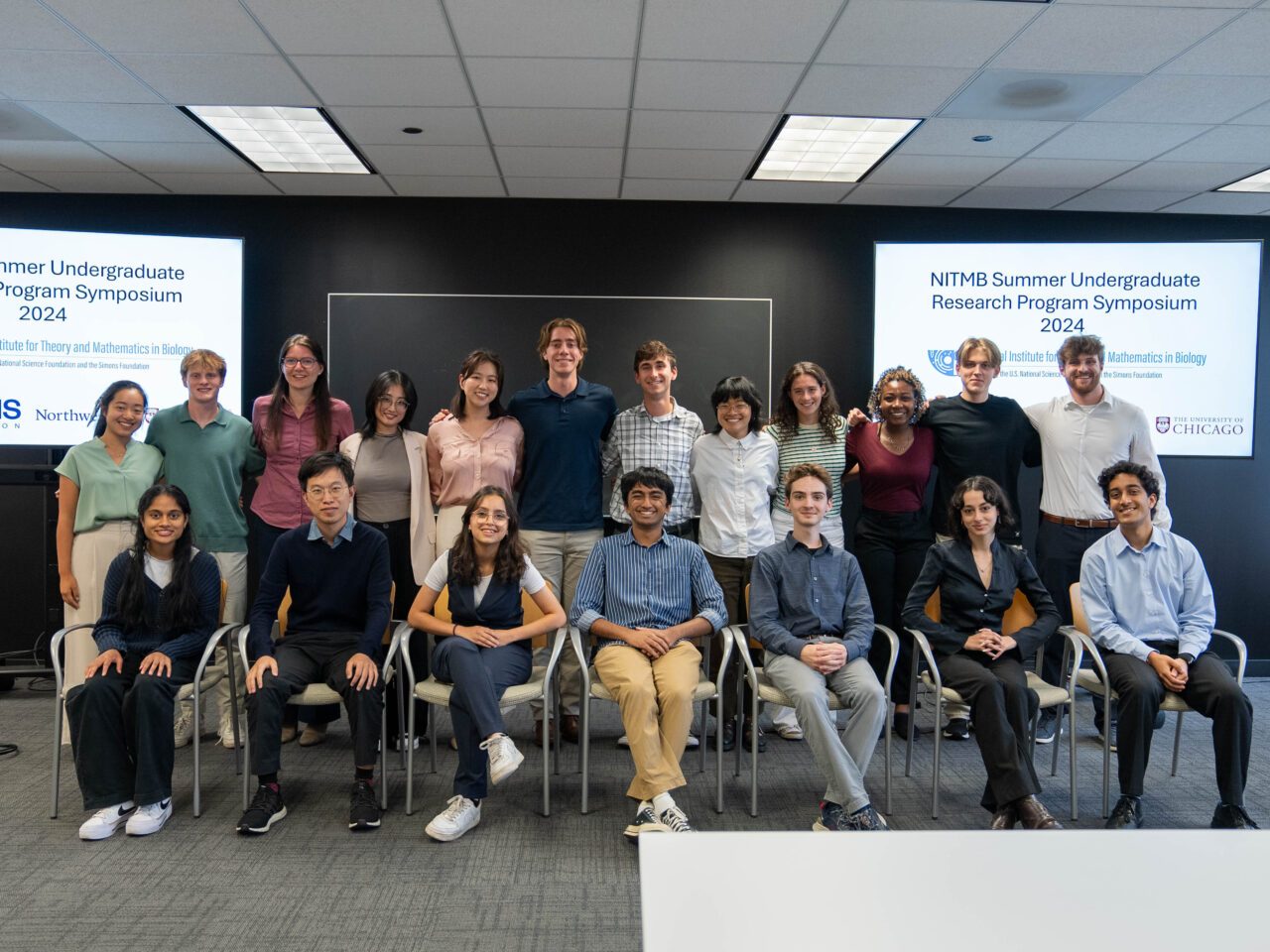
2025 Summer Undergraduate Research Program Participants
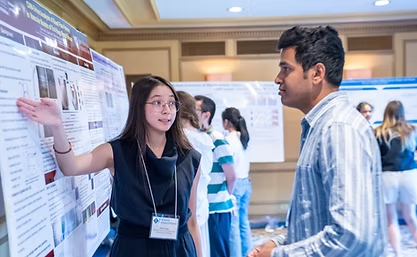
“The program has given me access to such an expansive support system at NITMB, Northwestern, and through the other participants. The program has also given me more confidence as a researcher and has cemented that research that intersects math and biology is a path worth pursuing.”


- Pratyush Rallapally (2024), undergraduate majoring in biology and statistics, University of California, Santa Barbara 

“Without a doubt, this cohort was most certainly the driving highlight of my summer.” 


- Evan Gibbs (2024), Undergraduate majoring in mathematics, York College of Pennsylvania 

DSC01167.jpg

Stipend & Support

Participants in the program receive a taxable stipend of approximately $6,500. Additionally, costs for a meal plan and housing will be covered by the NITMB. Travel costs to/from the site will be reimbursed up to $350.00. Local transportation (Metra/CTA) card will be covered for the 8 weeks.

​

Eligibility

To be considered for this program, applicants must currently be freshmen, sophomores, or juniors with demonstrated interests in biology, mathematics, physics, statistics, computer science, data science, and related fields. Applicants will be prioritized based on their demonstrated interest to learn and/or research at the interface of mathematics and biology.​

Participants will attend cohort outings and weekly workshops on research computing, scientific communication, applying to graduate school and fellowships, and other career development topics. The program will culminate in students presenting their work at the NITMB Math-Bio Convergence Conference, an annual conference that draws researchers from around the world.

​

This program is run by the National Institute for Theory and Mathematics in Biology and supported by the National Science Foundation and the Simons Foundation.

"NITMB and my experience in this summer program has given me a look at what is really being done at this mathematical-biological interface. It has introduced me to different ways of thinking and widened my perspective.”  â€‹


- Helen Yoo (2024), undergraduate majoring in chemistry and music, Bradley University 

DSC04168.jpg

Anika Nazhat, 2025 Summer Undergraduate Research Program Participant
Zihan Yang, 2025 Summer Undergraduate Research Program Participant
Expectations

  • Participants are expected to devote 100% full-time effort (defined as 37.5 hours/week) to research and mandatory institutional activities during the eight-week period, June 22 - August 15, 2026.

  • Participants must agree not to take on any other paid work or research grants for any part of the eight-week period, and must not be enrolled in courses for any part of that period.

  • Participants are expected to present a poster at the end of the program.

2025 Participant Testimonials 

​Explore the research and experiences of participants in the 2025 Summer Undergraduate Research Program

National Science Foundation logo
Simons Foundation Logo

Funded by
US National Science Foundation DMS-2235451
and Simons Foundation MP-TMPS-00005320

Location icon

Mailing Address

875 N Michigan Ave.

Suite 3500

Chicago, IL, 60611

Building Entrance

172 E. Chestnut St.

Northwestern University logo
The University of Chicago logo
  • Youtube
  • X
  • LinkedIn
  • Instagram
  • Facebook

©2025 NSF-Simons National Institute for Theory and Mathematics in Biology

bottom of page