
Chicago, IL 60611 United States


Overview
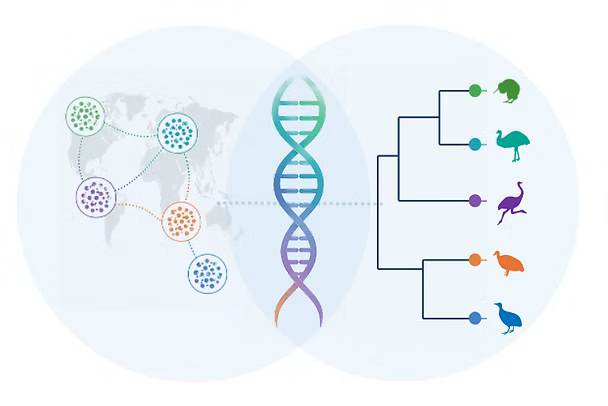
Understanding evolutionary history from genetic data is a central challenge in modern biology. Traditionally, phylogenetics and population genetics have approached this problem at different scales, phylogenetics focusing on relationships among species over long timescales, and population genetics examining processes within species over shorter timescales. However, the rapid growth of genome-scale data is blurring these boundaries and revealing increasingly complex, non-treelike patterns of evolution driven by recombination, gene flow, and hybridization.
This workshop will bring together researchers from mathematics, statistics, and biology to explore the shared foundations of these fields and to develop new integrative approaches for modeling and inference. A particular focus will be on connections between ancestral recombination graphs and phylogenetic networks, which, despite arising in different contexts, are mathematically equivalent structures used to represent reticulate evolutionary histories.
The program will emphasize collaboration and discussion, featuring a tutorial day to establish common ground across disciplines, followed by time for focused working group sessions as well as research presentations. Participants will identify key challenges, compare modeling frameworks, and initiate new research directions at the interface of stochastic processes, graph theory, and evolutionary biology.