Exploring microbial communities with mathematical models: A conversation with Sergei Maslov


The NSF-Simons National Institute for Theory and Mathematics in Biology is composed of investigators at the forefront of innovative research at the interface of mathematics and biology. NSF-Simons NITMB Affiliate Members bring unique perspectives vital for developing new mathematics and inspiring biological discovery. One such NITMB Affiliate Member exploring microbial communities with computational methods and tools is Sergei Maslov.
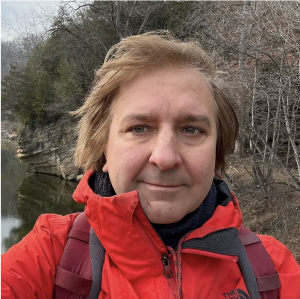
Sergei Maslov is a Professor of Bioengineering and Physics at the University of Illinois Urbana-Champaign (UIUC). At UIUC, he also co-directs the Center for Artificial Intelligence and Modeling within UIUC’s Carl R. Woese Institute for Genomic Biology, which is also the home of Professor Maslov’s research group. The focus of the Maslov Lab at UIUC is on computational models of microbial ecosystems, including publications on deep learning, origin of life, epidemiology, genome evolution, and structure and function of biomolecular networks. Professor Maslov is also a principal investigator on the NITMB-supported research project, ‘Mathematical Frameworks for Stability, Evolution, and Control in Microbial Communities.’
We spoke with Sergei Maslov to learn more about his work expanding our understanding of the complexity of life.
What is a big question you’ve been asking throughout your research?
“My degree is in theoretical physics, and I got my PhD at Stony Brook University in New York. There, I realized I wanted to do something slightly more interdisciplinary than mainstream physics. I can pinpoint almost exactly when I decided to do biology for most of my research portfolio. It was in 2001 there was the first conference for theoretical physicists who want to switch to biology was held at the Kavli Institute for Theoretical Physics in Santa Barbara (at the time it was just ITP Santa Barbara). I spent six months in Santa Barbara, interacted with biologists, and interacted with physicists who were pretty much all incredibly naive about biology, but eager to learn. I was among them, and I made this switch, and I never regretted it. Now it’s been almost 25 years, and my focus remains the same. I want to understand what makes biology so complex. My primary motivation for switching to biology is that I realized that nothing rivals biological systems in sheer complexity and sheer intricate dynamics of parts, and how it was all created without supervision, just by the force of evolution, which is what I’m trying to understand. Usually, I don’t stay in one subfield of biology for more than seven years because only then can I have a fresh mind about it and not become too much of a kind of expert in the little details of one subfield. My main subfields were systems biology and networks for the first seven years (give or take), bacterial genomes and their evolution for the next seven, and then I made a big jump to Illinois in 2015. Here, I started a new research area for me, microbial ecology. Now my research portfolio is probably 70% in microbial biology, and the remaining 30% is still in systems biology. By and large, I’m interested in microbial ecology. Microbial ecology itself can be subdivided into two directions. One is how microbes interact with phages, which are viruses infecting bacteria. The other is how microbes compete for resources and how this competition leads to survival of some and extinction for others, especially in ecosystems where there are boom and bust cycles.”
What disciplines does your research integrate?
“Statistical physics is the foundation on which I built my understanding. I’m also quite fluent in the main areas of modern mathematics, including game theory. Some of my recent work incorporated the well-known game theoretical approaches, which are known as the stable marriage model or stable matching model. As far as I know, I was the first person to apply them to questions in microbial ecology or in ecology in general. Dynamical systems clearly play a role. We study the dynamics of the systems, the trajectories, and bifurcations (or phase transitions as they are known in physics).”
Where do you find inspiration?
“Inspiration is in nature itself. I am watching lots of nature documentaries by David Attenborough and others. There are no good nature documentaries about microbial ecosystems because it’s very hard to film them and to have something compelling. I am fascinated by evolution on long time scales, just to think about the billions of years that separate us from the origin of life, which is another area I have a little research footprint. I started working on a simple model of replication of polymers at the dawn of life, and we have about four or five papers on this topic with my collaborator Alexei Tkachenko. Alexi and I were among the organizers of the conference here at NITMB in May this year on the origin of life, where we brought together people who study chemistry at the dawn of life, like Jack Szostak and the community of physicists who are a little little less focused on what exactly happened 3.8 billion years ago on Earth. Physicists are asking, can we make non-living systems into living systems in a lab? This is known as soft matter physics, and it deals with things like self-assembly, self-replication, and so on.”
What aspects of your work could be interesting to mathematicians or applied to biology?
“I feel there are many areas where mathematicians can contribute to biology. A lot of times, the challenge is learning the language. Biology is messy and, unfortunately, a poor subject for pure mathematical theorems, so each party needs to be open-minded. But mathematicians working on game theory or control theory (which is sort of mathematics/engineering) and dynamical systems, including topological methods to study dynamical systems, and so on, can contribute. Interesting anecdote: In 1992, I took a game theory course and learned about the stable marriage problem. I brought the problem into statistical physics, leading to about 10 or 15 papers, and I returned to those ideas when working on microbial ecosystems 25 years later.”
What about the NITMB do you find exciting?
“NITMB is a fantastic place to visit. It has a very strong cohort of Fellows. I was lucky to be here when a new batch of postdoctoral fellows were presenting their research. I was excited about each and every single one of them. I feel like NITMB will foster those collaborations first by being a very attractive place to visit. Everybody wants to be in Chicago, and the views and facilities at the headquarters are fantastic. And the fact that NITMB can provide the logistics and financial support for the conferences is fantastic. My collaborators and I are planning to leverage this new opportunity for small group visits. The challenges will remain the same–how to get the two sides, biologists and mathematicians, to talk to each other. I’m quite familiar with this because I co-direct the Center for AI and Modeling here at the Institute for Genomic Biology. Me and my co-director, Olgica Milenkovic, both worked on biology for many decades and appreciate what kind of data biology usually generates. A lot of the time, this data is not immediately appropriate for the application of some sophisticated mathematical or computer science algorithms. So somebody needs to put the effort into softening mathematics or computer science, and hardening biological data, so there will be a meeting spot. That is exactly the same challenge for people at NITMB as they explore how to be efficient matchmakers between biologists and mathematicians.”
What career achievement are you most proud of?
“I’m proud to have a career in science. I come from a family of scientists. Both my parents are professors of physics, two of my grandparents are physicists, my sister is a physicist, her son is a physicist, and two of my sons major in physics in college. It’s a great privilege to be paid to do something as exciting as science. I’m proud that I managed to reach my stage of career in science and not get buried in one particular subfield of science. I want to keep my footprint much larger, and maybe that will come at the expense of my footprint not being as deep, but it will be broad.”
Outside of your research, what other interests do you have?
“I love hiking and skiing. Unfortunately for skiing, I came to the wrong place because I cannot ski in Urbana. But I go skiing twice a year to different ski resorts all around the country and in Europe. I hike every weekend, and I like nature. I like music, especially jazz music. When I visit NITMB, I always go to at least a couple of jazz clubs in Chicago.”
What are you hoping to work on in the future?
“There are plenty of directions. If anything, my challenge right now is to focus a little bit more. The proposal I submitted to NITMB and got funded to do concerns the mathematical aspects of microbial communities and microbial ecology, including developing further the application of game theory and dynamical systems and topology, and so on. That’s something I definitely will do in the next two years. Secondly, the group I’m part of recently received a big ARPA-H grant to develop phage cocktails for oral pathogens. That will involve a lot of machine learning and mechanistic modeling of phage bacterial interactions. Then the research on systems biology will continue. In my group, we have some exciting algorithms about how to analyze single-cell transcriptomic data without knowledge about splicing variants. During the Origin of Life conference at NITMB, we convinced one of the experimentalists from NYU, Paul Chaikin, and his graduate student Lev Bershadsky, to do some experiments testing our theory with Alexei Tkachenko. Also, I plan to visit NITMB reasonably often. It’s an exciting two years ahead.”
More information on Sergei Maslov’s work is available on his Google Scholar profile and on the Maslov Lab website.
Related Posts