The NSF-Simons National Institute for Theory and Mathematics in Biology is composed of investigators at the forefront of innovative research at the interface of mathematics and biology. NSF-Simons NITMB Affiliate Members bring unique perspectives vital for developing new mathematics and inspiring biological discovery. One such NITMB Affiliate Member harnessing statistical physics and soft condensed matter physics to drive biological discovery is Trevor GrandPre.
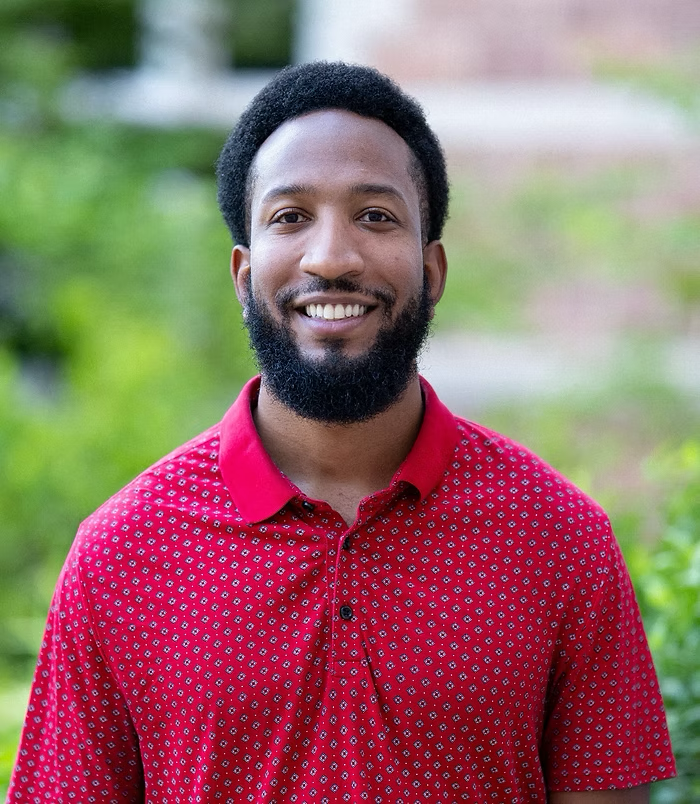
Trevor GrandPre is an assistant professor of physics at Washington University in St. Louis. The GrandPre group focuses on non-equilibrium statistical physics and soft condensed matter physics, with an emphasis on criticality in biology.
We spoke with Professor GrandPre to learn more about his work applying physics concepts to biomolecular condensates.
What is a big question you’ve been asking throughout your research?
“One central question of my research is how phase transitions and collective phenomena shape biological function, or what I like to call unconventional active matter. One area that I study is biomolecular condensates. These are membrane-less compartments formed through phase separation, meaning there’s some phase of proteins that are enriched and localized at some high concentration, and there are other areas that are depleted. The enriched phase is the biomolecular condensate. This is analogous to liquid-vapor phase separation in statistical physics.”
What disciplines does your research integrate?
“My research integrates a lot of areas, such as statistical physics and applied mathematics techniques. Some of the main topics are critical phenomena, stochastic calculus, large deviation theory, and control theory. Those are a mix of physics and math topics, but my research also integrates areas such as cell biology and eco-evolutionary systems.”
Where do you find inspiration?
“Biology is interesting and complex by itself, but it’s a good challenge to try to model it with math and physics. That’s what is inspiring, knowing that you can quantify the interesting biological systems that are studied. I also get inspiration from seeing elegant math or physics and having it applied to biology. That intersection is really what motivates me.”
What aspects of your work could be interesting to mathematicians or applied to biology?
“Much of my work is modeling biological systems. For instance, I will usually use stochastic differential equations rather than deterministic partial differential equations. This is important for some systems, especially in cells, because a lot of them are intrinsically noisy. You need to have that stochastic nature included. A lot of my work draws on stochastic calculus, path integrals, and so-called Fokker-Planck equations, which are naturally related to questions that applied mathematicians care about. In addition, I also use large deviation theory, a subject that comes from math, but is now being applied to physical systems and deals with trying to predict probability distributions and relate them to rare events.”
What about the NITMB do you find exciting?
“NITMB focuses on two things that I really like, math and biology. I feel like I have a home here. There’s a collection of scientists and researchers who all have similar interests. I also like that the Institute encourages interdisciplinary research. It brings together a lot of people who are experimentalists and don’t traditionally think about math or modeling. And then there are many people who are very applied, doing math that I like to call ‘fancy math.’ It’s very elegant within itself, but it’s hard to sometimes see how it can be applied to experimental systems. I like all of these.”
What career achievement are you most proud of?
“I’ve recently become a faculty member, that’s the thing I’m most proud of. I am aware that it is getting incredibly difficult to get professor jobs. I’m grateful to be able to continue to do science and to lead a research group.”
Outside of your research, what other interests do you have?
“I like to look for ways to engage and socialize with the broader scientific community. I’ll often look up opportunities at my home institution or in the surrounding city to network and meet new people, both scientists and those who are not scientists.”
What are you hoping to work on in the future?
“One area I’m interested in is using my background in stochastic systems and large deviation theory to understand immunology systems. For example, during infection the adaptive immune system undergoes a sharp, phase transition-like shift in its state, marked by rapid changes in clonal composition. Certain phenotypes and genotypes are strongly enriched, while others are depleted, as the immune repertoire adapts to combat pathogens. These dynamics naturally involve stochasticity, rare events, and selection, making them well suited to the tools I work with. I’m interested in bringing these approaches into immunology, particularly in ways that connect immune dynamics to broader eco-evolutionary systems.”
More information on Trevor GrandPre’s work is available on the GrandPre Group webpage, the University of Washington in St. Louis website, and on Professor GrandPre’s Google Scholar page. Professor GrandPre is also open to collaboration and discussing work over email.