Uncovering how the brain makes decisions with computational methods: A conversation with Tahra Eissa


The NSF-Simons National Institute for Theory and Mathematics in Biology comprises a wide array of investigators driving innovation at the interface of mathematics and biology. NSF-Simons NITMB Affiliate Members bring unique perspectives vital for developing new mathematics and inspiring biological discovery. One such NITMB Affiliate Member using computational methods to advance our understanding of how the brain makes decisions is Tahra Eissa.
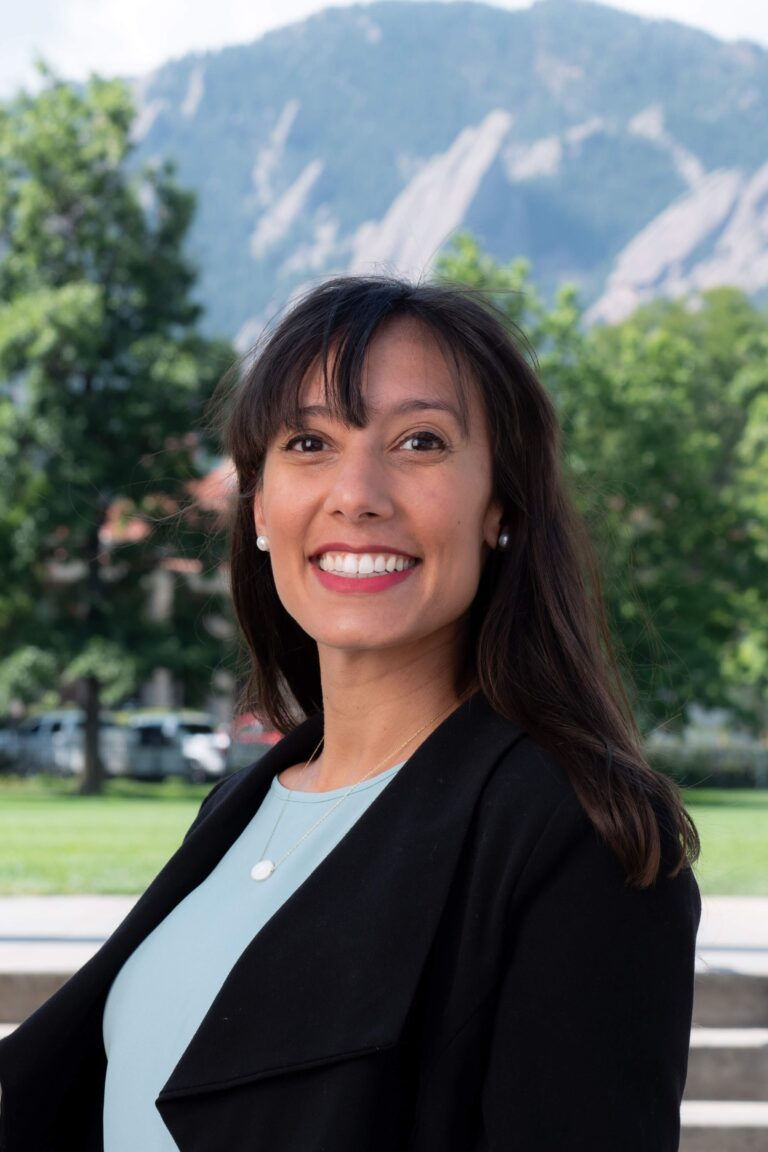
Tahra Eissa is an Assistant Professor in the Department of Physiology and Biophysics at the University of Colorado Anschutz School of Medicine. The Eissa Lab uses decision-making games, human brain recordings, and mathematical modeling to uncover how the brain makes decisions in a changing world, the strategies people use, and how the brain computes them.
We spoke with Professor Eissa to learn more about her research, the integration of mathematics and biology in a neuroscience context, and how NITMB can help advance this work.
What is a big question you’ve been asking throughout your research?
“I am interested in how our brains can flexibly update our cognitive strategies to match our current environment. At the core of this question is how we learn latent contextual features, like the probability that an environment might change (like the weather).”
What disciplines does your research integrate?
“I am a computational neuroscientist. I draw from neuroscience, psychology, Bayesian inference, and dynamical systems. I both run experiments, such as online behavioral tasks and recording brain activity from epilepsy patients, and am actively involved in computational modeling and theory, including building behavioral models that can mimic human strategies and developing neural network models that can help us interpret how brains perform complex cognitive functions.”
Where do you find inspiration?
“Working previously with scientific outreach and children’s programs and now having a toddler of my own, I find it fascinating and inspiring to see how others learn to solve complex problems. We take for granted how easily we complete what are actually quite complex cognitive tasks and the wide range of solutions you can take to solve them.”
What aspects of your work could be interesting to mathematicians or applied to biology?
“My work directly links biology (neuroscience) and math (modeling). I think that many of the methods that we apply in our lab could be applicable for a number of other questions, including developing new biological experiments.”
What excites you about NITMB?
“I find the atmosphere and the ability to connect with others who have relevant experiences to be very motivating. I am very excited to engage in more of the workshops that feel extremely relevant to the work I am doing. Being at NITMB has fostered a new set of collaborations and discussions.”
What career achievement are you most proud of?
“I recently became tenure-track faculty and am opening my own lab. This has been one of my greatest achievements and one of my biggest goals for many years.”
Outside of your research, what other interests do you have?
“I enjoy playing music, baking, running, and hiking.”
What are you hoping to work on in the future?
“I am starting to dive into incorporating game theory into my work, deviating from just mechanistic neuroscience. On the other extreme, my lab has now begun more translational work and is beginning to work at the border of computational psychiatry.”
Is there anything else you would like the NITMB community to know about you?
“I am originally from Evanston and had my first research position at Northwestern’s Medical School, so coming to NITMB is very ‘full circle’ for me.”
More information on Professor Eissa’s work is available on the Eissa Lab website.
Related Posts