Estimating evolutionary processes from large-scale data: A conversation with Laura Kubatko


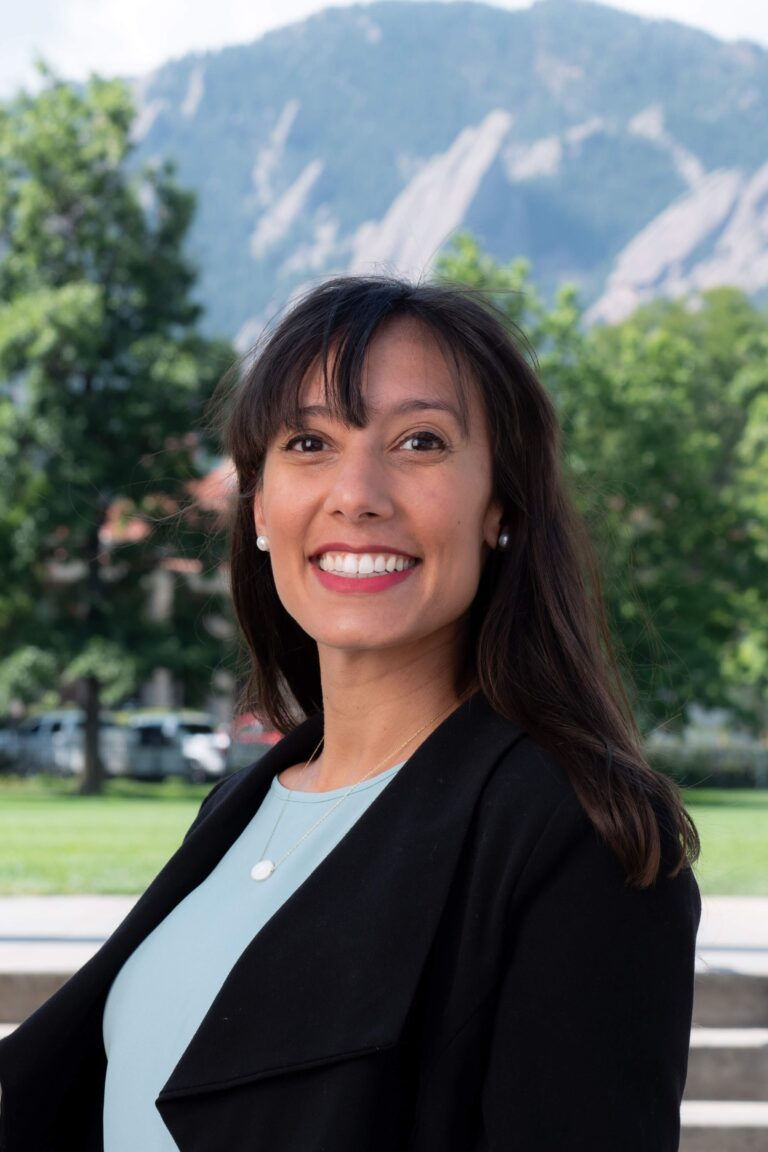
Laura Kubatko is a Professor of Evolution, Ecology, and Organismal Biology (EEOB) and of Statistics at Ohio State University (OSU). Her research focuses on estimating evolutionary relationships, typically represented by a phylogenetic tree, among species using genome sequence data. A specific focus of Kubatko’s work is the development and implementation of models across scales from within populations to across species.
“The focus of my research is developing computationally efficient ways to estimate evolutionary processes from large-scale data under realistic models for DNA sequence evolution. A central question has been robustness to violations of model assumptions, since genome evolution is difficult to model! One of the most interesting questions concerns evolutionary processes that lead to the transfer of genetic material “horizontally” – i.e., between species at a specific point in evolutionary time. Such processes include hybrid speciation and gene flow. Modeling these has become a recent focus for me, and has led to modeling using phylogenetic networks.”
What disciplines does your research integrate?
“My research is at the interface of statistical inference and evolutionary biology. In order to solve statistical problems in an evolutionary context, I draw on methods and models from stochastic processes, discrete mathematics, and even algebra. A primary focus of my work is providing methodology, typically in the form of software, that can be used by empiricists. In this component of my work, I draw heavily on computer programming and algorithm development.”
Where do you find inspiration?
“Most of my research ideas come from talking with empirical biologists. I am inspired by their field work to collect samples and the subsequent lab work required to obtain genomic data from those samples. I am always on the lookout for cases where they can identify a compelling problem for which an appropriate methodology has yet to be developed. Trying to find solutions that can be immediately applied to a data set is my motivation.”
What aspects of your work could be interesting to mathematicians or applied to biology?
“I am currently working on problems for which model identifiability is a central issue. These problems have an important impact on biology, as they give insight into what can or cannot be inferred from genome-scale data. Mathematically, the techniques used for proving identifiability are often interesting, and range from straightforward approaches showing that solutions to systems of equations exist to algebraic techniques.”
What excites you about NITMB?
“The U.S. math and biology institutes have played an important role in my research throughout my career. For example, I served as Associate Director and later Co-Director of OSU’s Mathematical Biosciences Institute (MBI) and was a member of the Board of Advisors at NIMBioS for several years. I benefited enormously in these roles as they afforded me access to branches of mathematics and biology with which I was not previously familiar. Particularly important in my research was a series of workshops on algebraic statistics at SAMSI. NITMB is thus very exciting for me! It provides an opportunity to both share my work with the broader math-bio community and to engage with others who work in these areas. I’m looking forward to participating in workshops and working groups!”
What career achievement are you most proud of?
“I have been fortunate to have a career that involves substantial engagement with multiple research communities, including mathematics, statistics, and evolutionary biology. I was proud to be serve as President of the Society of Systematic Biologists (SSB), and have been grateful that the community has welcomed the contributions of a statistician! I was also proud to be elected a Fellow of the American Association for the Advancement of Science (AAAS).”
Outside of your research, what other interests do you have?
“Academically, I’ve always been interested in teaching statistical material to biologists at all levels, from introductory undergraduate courses to graduate level work. Outside of work, I enjoy doing anything outdoors. I have done section backpacking trips on the Appalachian Trail and have done several multi-day bike trips (including two with fellow math biologist and NITMB-affiliate Kristina Wicke!). I am married with two sons (22 and 24 years old) and have recently adopted a timid rescue dog.”
What are you hoping to work on in the future?
“My current work is focused on methods that use composite likelihood approaches as means of approximating the true likelihood function, which is generally computationally intractable for realistic models of genome evolution. I am working on software to implement the method, and the approach allows great flexibility in terms of what models are included. I am hopeful that the research community will see the value of the approach, and new models can be added to expand the set of problems that can be addressed with the method.”
More information on Professor Kubatko’s work is available on her website. Several talks are also available on YouTube, ranging from a broad overview talk given for the SSB Presidential Address (2022) to more specialized introductory talks, such as her PhyloSeminar Talk in 2017. Professor Kubatko is also co-organizing, with Professor Kristina Wicke, the upcoming NITMB workshop “Phylogenetics Meets Population Genetics: From Trees to Networks.”
Related Posts